Employment Procedure for Nurses in Germany
If you are a qualified nurse and would like to work in Germany, the process usually involves several stages: an initial assessment of your qualifications, finding a suitable employer, recognition of your professional qualification, immigration formalities where applicable, and, if required, an adaptation programme or knowledge test.
Ost-West Medpersonal supports international nurses throughout this process — from the first consultation to employment with a German healthcare provider.
Step 1. Initial Consultation and Assessment
The first step is to assess your professional background and discuss suitable employment opportunities in Germany.
At this stage, we review:
- your nursing qualification and country of training;
- your professional experience;
- your current level of German;
- your preferred region or healthcare facility;
- the most appropriate route towards recognition and employment.
We also explain the main stages of the recognition procedure and the German language requirements.
Step 2. Finding a Suitable Employer
Based on your qualifications and preferences, we help identify suitable employment opportunities with German hospitals, clinics and other healthcare providers.
Candidates usually have an interview with Ost-West Medpersonal followed by an interview with the prospective employer.
Once an employer has been selected, the recognition and employment process can be coordinated with the competent authority in the relevant federal state.
Step 3. Recognition of Your Nursing Qualification
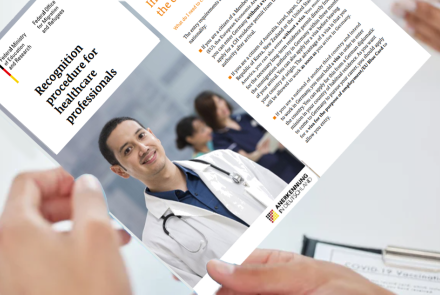
Nursing is a regulated profession in Germany. To work under the professional title of a qualified nurse, your foreign professional qualification must be recognised.
For qualifications obtained outside the EU, EEA or Switzerland, the competent German authority generally carries out an individual equivalence assessment. It compares the content and duration of your nursing education with the German reference qualification and may also take relevant professional experience into account.
The result may be:
- full equivalence of the qualification; or
- identification of substantial differences that must be compensated for.
If substantial differences are identified, you may be required to complete an adaptation programme or pass a knowledge test.
The competent authority usually reviews the submitted documents within approximately 3–4 months, provided that the application is complete.
If substantial differences are identified, the applicant may be required to complete an adaptation programme or another compensation measure before full recognition can be granted.
In practice, the entire recognition process — from the submission of documents to full professional recognition — often takes around 6–8 months, and in some cases may take up to a year, depending on the recognition decision, the required adaptation measures, the availability of training places and the individual circumstances of the applicant.
For detailed information about the documents required for recognition, see our guide:
**Required Documents for Nursing Diploma Recognition in Germany**
Step 4. German Language Requirements
German language skills are essential for working safely and independently as a nurse.
For full professional authorisation, nurses generally need German at **B2 level according to the Common European Framework of Reference for Languages (CEFR)**. Depending on the federal state and competent authority, profession-specific language skills may also have to be demonstrated.
You do not necessarily need to have completed B2 before starting the recognition or recruitment process.
Depending on the individual immigration and recognition route, it may be possible to enter Germany with a lower level of German and continue language training after arrival.
Step 5. Visa and Entry to Germany
Nurses from third countries generally require an appropriate visa or residence permit to enter Germany for employment or for measures connected with the recognition of their professional qualification.
The appropriate immigration route depends on the individual case.
For example, if the recognition authority has identified substantial differences in your qualification, it may be possible to enter Germany for an adaptation programme under the rules for recognition of foreign professional qualifications.
Another option in suitable cases is a recognition partnership, which allows the recognition procedure to continue in Germany in cooperation with the employer.
Ost-West Medpersonal assists candidates and employers in preparing the documents required for the relevant immigration procedure.
Ukrainian Citizens Already Living in Germany
Ukrainian citizens who already have a residence status in Germany that permits employment — for example, temporary protection under Section 24 of the German Residence Act — generally do not need to apply for a separate entry visa before starting the employment and recognition process.
The individual residence status should always be checked before employment begins.
Step 6. Adaptation Programme or Knowledge Test
If the recognition authority identifies substantial differences between your nursing qualification and the German reference qualification, these differences must be compensated for before full professional recognition can be granted.
Depending on the official decision and the individual case, this may be achieved through:
an adaptation programme (Anpassungslehrgang); or
a knowledge test (Kenntnisprüfung).
An adaptation programme allows candidates to acquire the knowledge and practical skills identified as missing by the recognition authority.
During this period, employment conditions, salary and accommodation depend on the employer, the type of programme and the federal state.
Ost-West Medpersonal coordinates the process with the healthcare provider and supports candidates during this stage.
Step 7. Full Recognition and Employment as a Qualified Nurse
After successfully completing any required compensation measure and meeting all other requirements — including the necessary German language skills, personal suitability and medical fitness — you can receive full professional authorisation.
You can then work in Germany under the recognised professional title and be employed as a qualified nurse.
Salary and employment conditions depend on the employer, collective agreement, professional experience and region.
How We Support You
Ost-West Medpersonal provides support throughout the entire process, including:
initial assessment of your qualifications and employment prospects;
selection of suitable employment opportunities;
communication with German healthcare providers;
preparation of the recognition procedure;
organisation of certified translations;
assistance with recognition documents;
support with immigration and employment documents;
coordination of adaptation measures where required;
support until you begin working with your German employer.
Our goal is to make the transition from your nursing qualification abroad to professional employment in Germany as clear and manageable as possible.
Start Your Nursing Career in Germany
The route to working as a qualified nurse in Germany depends on your professional qualification, language skills and individual recognition result. For some candidates, recognition is straightforward; others may need an adaptation programme or knowledge test.
With the correct preparation and professional support, each stage — from recognition to employment — can be planned in advance and completed step by step.